
She finished an eight-hour shift, commuted forty-five minutes home, and then walked straight into the kitchen. Her husband was on the couch. Nobody asked her to start cooking. And yet, nobody had to.
This happens in millions of Indian homes every evening. Yet, it doesn’t happen because of laziness or bad intentions. In fact, this pattern is so deeply embedded in daily life that it has become invisible — both to the people living it, and furthermore, to the economy that depends on it.
In 2019, India’s government decided to count it. As a result, the Ministry of Statistics and Programme Implementation — MoSPI — conducted the country’s first comprehensive National Time Use Survey. It asking nearly half a million people to record every activity they performed across a full 24-hour period, in 30-minute slots. Consequently, the 2,140-page report that followed is one of the most important documents about Indian women’s lives ever published. And yet, almost no one has read it.
In February 2025, MoSPI released the second edition of the survey, covering 2024. Notably, the findings confirmed what the first survey showed — and moreover. It added a five-year report card that is, depending on how you look at it, either a small improvement or a quiet indictment.
The numbers are uncomfortable. They are also irrefutable.
What Is the MoSPI Time Use Survey — and Why Does It Matter?

Before getting to the numbers. it’s worth understanding what this survey is and why it is so significant.
A Time Use Survey does exactly what the name suggests: it measures how people actually spend their time. In other words, not what they say they do, and not what they think they do but rather what they actually did, hour by hour, across an ordinary day.
Notably, India is one of only a handful of countries in the world that conducts this survey at a national scale — including the United States, Japan, Australia, South Korea, China, and New Zealand. The 2024 edition covered 139,487 households across both rural and urban India, collecting data from 454,192 individuals aged six and above.
The survey distinguishes between paid activities — salaried work, self-employment, business — and unpaid activities, which include domestic work like cooking, cleaning, and washing, as well as caregiving for children and elderly family members. Unpaid work is work. It takes time, energy, and physical effort. It simply doesn’t come with a salary.
For decades, this work has been invisible in the national accounts. However, the Time Use Survey makes it visible. As a result, what it reveals about the distribution of that work between men and women is something every Indian household should reckon with.
The Number Nobody Is Talking About: 289 Minutes
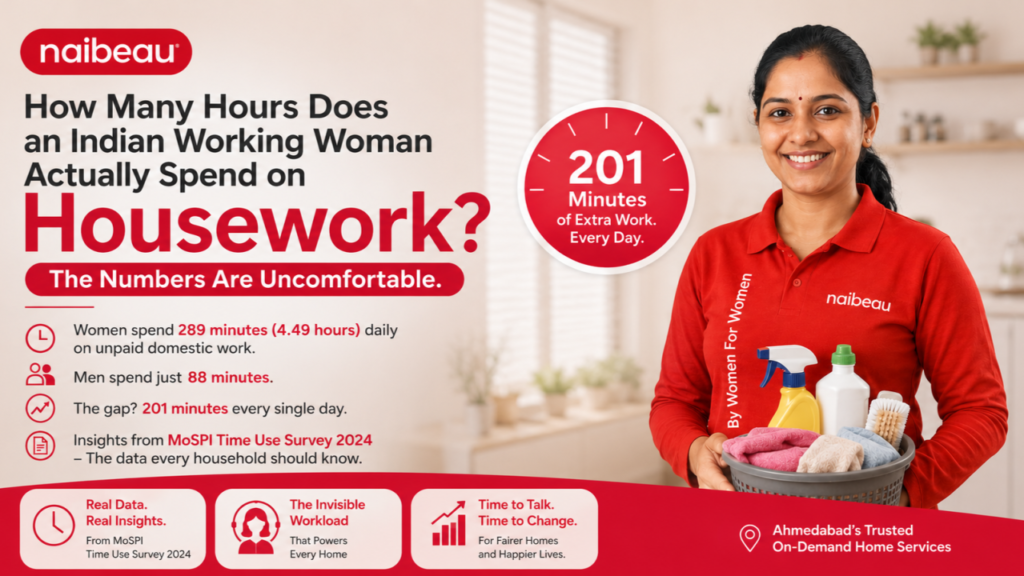
According to the MoSPI Time Use Survey 2024, Indian women spend an average of 289 minutes every day on unpaid domestic work for household members.
That is four hours and forty-nine minutes. Every single day.
To understand what 289 minutes actually looks like, consider what it contains: preparing breakfast and packing lunch boxes before anyone else in the house is awake. Washing dishes after two meals. Doing laundry and folding clothes. Sweeping and mopping. Buying vegetables. Cooking dinner. Wiping the kitchen counter at 10pm before finally sitting down.
None of these happen in one block. Instead, they are scattered across the day in fragments — 20 minutes here, 40 minutes there — which is precisely why they are so easy to overlook. On the surface, they feel like nothing. And yet, they add up to nearly five hours.
The men’s number? 88 minutes.
The gap is 201 minutes — over three hours of extra unpaid work every day. This is on top of everything else Indian women already do.. Over a year, that gap adds up to more than 51 full days of extra work. It goes unacknowledged, uncompensated, and largely undiscussed.
Five Years, 10 Minutes: The Report Card
One of the most important things about the 2024 survey is that it gives us a comparison point.
In 2019, women spent 299 minutes per day on unpaid domestic services. By comparison, in 2024, that number came down to 289 minutes — representing a reduction of just 10 minutes over five years.
On the surface, this looks like progress. But look at what happened on the men’s side. In 2019, men spent 97 minutes on unpaid domestic work. In 2024: 88 minutes. Men actually reduced their contribution over the same period.
The gap in 2019 was 202 minutes. The gap in 2024 is 201 minutes.
Five years of economic growth. Rising female workforce participation. Urban expansion. A global pandemic that forced everyone home and made domestic work impossible to ignore. And the daily domestic burden on Indian women moved by less than the length of a television episode.
This is not a rounding error. It is a structural condition.
The Finding That Should Change How We Talk About “Working Women”
Here is the number that the ORF’s analysis of the Time Use Survey found most striking — and the one that most directly challenges a comfortable assumption:
Women with higher education and their own income do not spend less time on unpaid domestic work.
The pattern holds regardless of educational qualification. It holds regardless of employment status. A woman with a postgraduate degree who works a full-time corporate job comes home to the same kitchen as a woman with no formal education. The degree didn’t reassign the dishes. The salary didn’t renegotiate who puts the children to bed.
This finding matters because it demolishes a quiet assumption that sits beneath a lot of well-meaning advice given to Indian women: that education and economic independence are sufficient, on their own, to change the domestic equation. The data says they are not. The equation itself has to change.
Women Work Longer Days Than Men — The Economy Just Doesn’t Count It
When you add paid and unpaid work together, the picture becomes even clearer.
According to the MoSPI Time Use Survey 2024, the average total daily work time — paid employment plus unpaid domestic and caregiving work — is 367 minutes for women and 307 minutes for men.
Women work a longer day than men. Every day. By an average of one full hour.
The perception that women “work less” or are “less productive” is built on an accounting system that counts only paid work. However, if you add the unpaid hours back in, the numbers reverse entirely. In fact, Indian women are, by any honest measure, among the most overworked people in the country.
The caregiving numbers add further weight to this. The survey found that 41% of women participate in caregiving for household members daily — spending an average of 140 minutes on it. Male participation in caregiving sits at 21.4%, at an average of 74 minutes. Only 4% of men are primary caregivers.
Caregiving — looking after children, the elderly, the ill — is not a peripheral activity. For 41% of Indian women, it is a significant portion of every working day. It sits on top of the domestic work, on top of the paid job, at the end of the commute.
The Hidden Price: What “Time Poverty” Costs Indian Women
Researchers have a term for what happens when someone’s day is so consumed by work — paid and unpaid — that there is no room left for rest, for ambition, for learning, for choosing how to spend their own hours.
Time poverty.
Unlike income poverty, time poverty has no visible marker. A woman experiencing time poverty may have a job, a salary, a clean home, and children who are fed and cared for What she doesn’t have is discretionary time. These are the hours to pursue a skill, attend a class, apply for a better job, or simply rest.
The economic consequences of time poverty are significant and largely uncounted.
India’s own government estimates that women’s unpaid domestic work is worth between 15% and 17% of the country’s GDP. This is work that runs the economy — that enables every employed man and every employed woman to leave home each morning with clean clothes and a meal in their stomach. It simply doesn’t appear in the economy. There is no line in the national accounts for it.
The ILO estimates that 708 million women worldwide are outside the labour force specifically because of caregiving and domestic responsibilities. The comparable number for men is 40 million. The ratio is not a cultural quirk. It is what happens when one gender absorbs the full cost of keeping a household functional while the other remains available for paid work.
And yet India spends less than 1% of GDP on care infrastructure — childcare, elderly care, domestic support services. That would meaningfully reduce this burden.
What This Looks Like in an Ahmedabad Home
The national data averages across rural fields and urban apartments . The across joint families and nuclear households, across all of India’s staggering diversity. But in a city like Ahmedabad — growing fast, full of dual-income households, with long commutes and small nuclear families — the specific shape of the problem is worth naming.
The working woman in Bopal or Satellite or Prahlad Nagar is likely carrying a disproportionate share of the 289 minutes. She probably has fewer extended family members nearby to share the load than her counterpart in a joint family setup. Her husband may genuinely intend to help more than he does. But intention, the data has consistently shown, does not translate into minutes.
The average working woman in urban India is managing a full-time job and a full-time home, without adequate infrastructure for either. She is not failing at work-life balance. She is succeeding against a structural deficit that the national surveys have now quantified, and that the national conversation has barely begun to address.
The 201-Minute Question
The Time Use Survey doesn’t tell Indian women anything they didn’t already know, somewhere in their bodies.
What it does is give that knowledge a number. 201 minutes. Every day. More than three hours of unacknowledged work that falls on one side of the household without conversation, contract, or compensation.
The survey was conducted and the data was published. Yet, it received a news cycle and then, largely, disappeared. This happened partly because it is 2,140 pages long, and also because data about unpaid work is inherently hard to make urgent. Most importantly, the people most affected by these numbers are too busy — by exactly 201 minutes per day — to spend much time reading reports about their own lives.
But the number exists now. It is government-certified, survey-verified, and updated as recently as February 2025.
201 minutes is not a gap that closes itself. It closes when the distribution of domestic work is treated as a genuine question — in households, in policy, and in the infrastructure built around how urban Indian families actually live.
Where On-Demand Home Services Fit Into This Picture
There is no single solution to a 201-minute gap. Changing the distribution of domestic work within households is a cultural and behavioural shift that takes generations, not apps.
But within that larger picture, practical infrastructure matters. Reliable, affordable help with the hours that can be delegated — the cleaning, the dishes, the mopping — is one small but real lever.
This is exactly the gap that platforms like naibeau are built around. Not to replace the relationship between a household and its home but to provide a verified, on-demand option on the days when the load is too heavy, the time too short, and the 289 minutes simply cannot all be absorbed by one person.
It won’t close the gap by itself. But for the working woman in Ahmedabad coming home after a full day with dishes in the sink and guests arriving in two hours, it is a start.
The survey has done its job. It counted the minutes. What happens to them next is up to us.
Key Data Points: MoSPI Time Use Survey at a Glance
For reference, here are the survey’s key findings on gender and domestic work:
Women’s daily unpaid domestic work: 289 minutes (2024) | 299 minutes (2019) Men’s daily unpaid domestic work: 88 minutes (2024) | 97 minutes (2019) The daily gap: 201 minutes — over three hour. very day Change in gap over five years: 1 minute Women’s total daily work (paid + unpaid): 367 minutes Men’s total daily work (paid + unpaid): 307 minutes Women in caregiving daily: 41% | Men in caregiving daily: 21.4% Value of women’s unpaid work as % of India’s GDP: 15–17% Survey coverage: 454,192 individuals, 139,487 households across India Survey conducted by: Ministry of Statistics & Programme Implementation (MoSPI) Latest edition released: February 25, 2025
Sources: MoSPI Time Use Survey 2019 and 2024; Observer Research Foundation (ORF) Occasional Paper No. 372. The Wire; Business Today; ILO Global Estimates on Women Outside the Labour Force.
Naibeau is an Ahmedabad-based on-demand home services platform connecting trained and verified domestic work professionals with urban households. Currently operational in select areas of Ahmedabad.