
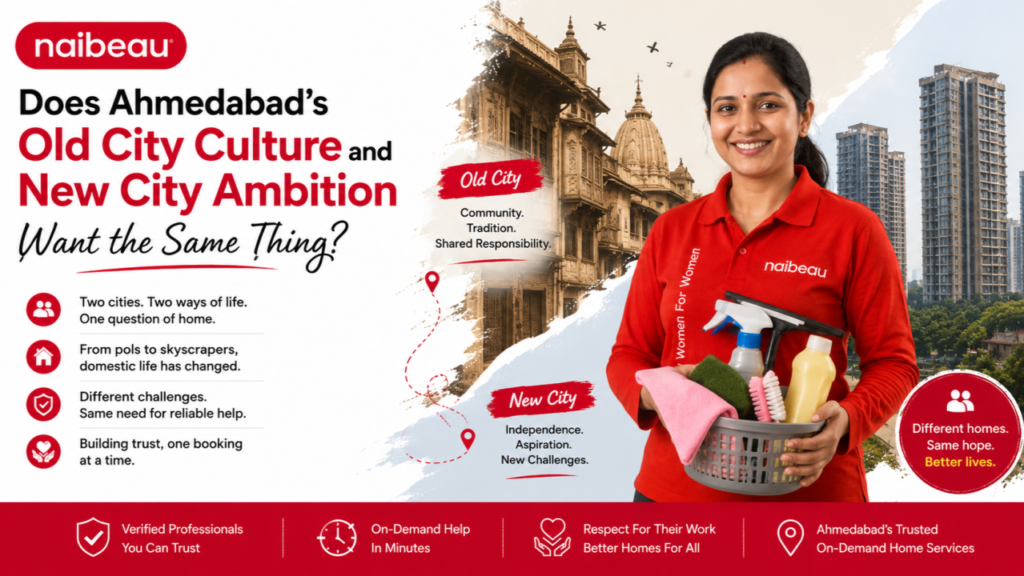
How the pols of the walled city and the high-rises of Prahlad Nagar and Bodakdev approach domestic work, the role of a maid, and the idea of home — and what that divide reveals about how a city of 8 million is changing.
There is a distinct morning in Ahmedabad’s old city pols—Kalupur, Dariyapur, and Jamalpur—that rarely happens in newer areas like Bodakdev. Here, neighbours share food, relatives help prep meals, and managing the household without a maid is an unspoken, shared community effort. Cross the Sabarmati River, and the morning changes completely. In a 12th-floor SG Highway apartment, a working couple rushes out by 9 AM, leaving behind unwashed dishes and unmopped floors. Their day’s order hinges entirely on one person: the maid. Her arrival dictates whether the morning begins smoothly or spirals into controlled chaos. Despite sharing the same city, these two distinct worlds face fundamentally different domestic realities. Yet, both are driven by the exact same underlying need: a home that runs.
Two Cities Inside One City
Founded in 1411 on the Sabarmati’s eastern bank, Ahmedabad is India’s first UNESCO World Heritage City. Its historic core features around 600 pols—densely packed, traditional housing clusters. These pols functioned as social operating systems rather than mere housing. By acting as self-contained neighbourhoods, they efficiently shared the daily labour of living across the entire community, preventing any single household from bearing the full domestic burden alone.
Across the river, western Ahmedabad has expanded rapidly into modern hubs like Satellite, Bopal, and the SG Highway corridor. Promising a modern, high-rise lifestyle, the city’s built-up area grew by 130% between 1990 and 2019. Though geographically close, these new neighbourhoods lack the old city’s organic community support. Consequently, when it comes to managing household chores and domestic help, these two Ahmedabads operate in entirely different worlds with distinct anxieties.
What the Pol Actually Was
To understand the domestic work divide in Ahmedabad today, it helps to understand what Ahmedabad’s pol culture actually provided — and what disappeared when families moved out of it. A pol would normally have one gate for access leading to many small lanes, virtually like small villages. These self-contained neighbourhoods provided security to residents, with community living and the sharing of resources. This form of housing was established during a time of divided rule — the walled city of Ahmedabad features rich wooden architecture, havelis, and pols — architecture deliberately designed to promote community, family, and multiculturalism.
In a functioning pol, domestic work was never entirely privatised. Cooking for festivals was collective. Childcare was shared across households. An older woman in the pol would naturally oversee younger children while parents worked. The domestic help, when hired, was known to the community — often a woman from a neighbouring pol whose presence carried the implicit vouching of the neighbourhood. The pol’s answer to domestic work was structural: distribute it. Make it a community function, not an individual burden.
This is not sentimentality. It is a practical description of how home management actually operated in dense, multigenerational, community-organised neighbourhoods. And it worked — not perfectly, and not without its own inequities, particularly for the women who bore most of that distributed labour — but it worked as a system.
When Gujarat Moved to Nuclear Families
What happened to that system when Ahmedabad began its westward expansion is the story of India’s urban transformation in miniature.
Gujarat and Maharashtra have experienced a faster shift to nuclear families than the national average, driven by higher urbanisation rates and economic mobility. Industrial and commercial hubs in these regions attract individuals and nuclear families, pulling them away from traditional setups.
Nationally, the picture is stark:
- Nuclear families account for approximately 70% of all households in India
- Joint and extended families together comprise only about 20%
- In urban areas, the proportion of nuclear households is even higher
- The number of nuclear households in India grew by over 29% between 2001 and 2011
Rapid urban growth and migration are the primary drivers of nuclear families, physically separating young adults from their ancestral homes. While modern education and a market economy have fostered economic independence and gender equality, urban constraints like high costs and limited space have made joint families impractical. In Ahmedabad, this shift followed a clear geographic pattern. The first generation leaving the pols often moved in extended family clusters. However, subsequent generations moved further west into isolated apartments entirely lacking shared community support. While providing individuals—especially women—with greater independence, this spatial and social fragmentation has dismantled traditional safety nets for women, children, and the elderly. Ultimately, the complete disintegration of this communal support system is the precise root of the domestic work crisis now experienced in Ahmedabad’s new city.
The New City’s Specific Maid Problem
In Bodakdev and Prahlad Nagar, the domestic work problem looks like this. A nuclear family of three or four — both parents working, children in school — lives in a high-rise apartment. There is no extended family in the building. There is no community of neighbours who have known each other for thirty years. There is no shared kitchen, no common courtyard, no aunt upstairs. There is a maid. One woman, hired through word of mouth, who comes every morning. She is the single point of failure in the entire domestic support system.
When she doesn’t show up — and she will, at some point, not show up — everything that was distributed across an entire pol community in the old city now has to be absorbed by whoever is standing in the kitchen at 7:45am. The anxiety this produces is specific to the new city’s structure. The urban woman today exercises far greater professional authority than before. She monitors children’s homework, manages school logistics, and runs the household while managing a career. She does all of this without the safety net that the pol once provided for free. This is not a personal failure. It is a structural one. The new city was built for modern ambition. Its infrastructure of domestic support was never redesigned to match.
Related: what to do if maid doesn’t show up | Why verified domestic workers matter more in high-rises than anywhere else
The Old City’s Different Relationship maid
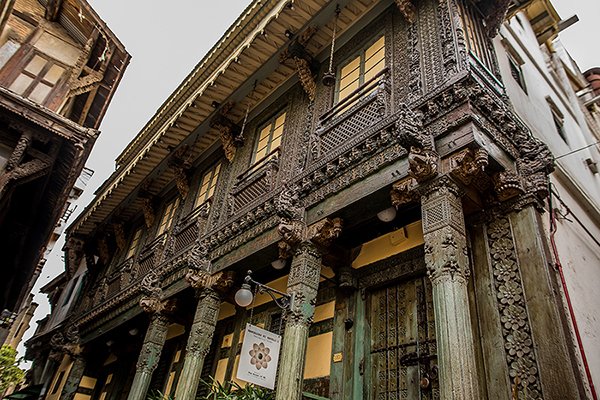
The relationship with domestic work in the walled city’s pols is not without its own complications — but it is structurally different in ways that matter. Joint family arrangements — still more prevalent in the older parts of the city — naturally distribute domestic labour. An elderly grandmother is present. A sister-in-law is nearby. The maid, where she exists, is supplementary rather than foundational.
People of Ahmedabad value family traditions and maintain close relations with relatives — following the norms of a joint family and respecting elders. In the old city’s pols, this cultural norm has remained more intact than in the high-rises of the west. The paradox, however, is worth naming honestly. The same joint family structure that distributed domestic labour also kept many women from leaving it. Women in joint families are not always free to pursue paid work outside the house — the joint family system historically kept women tied to domestic roles even as it shared the burden of them. The old city’s domestic arrangement solved the logistics problem.
It did not necessarily solve the equity problem. In many pol households, the domestic burden is distributed — but distributed primarily among the women of the household, not between men and women equally. Two different systems. Two different imperfect solutions to the same fundamental challenge.
What Moving Into a High-Rise Actually Costs

The people who moved from Ahmedabad’s walled city to its new neighbourhoods gained a great deal. Privacy. Space. Modern amenities. Distance from the density of the old city. Access to schools and hospitals and malls along SG Highway.
What they lost was not immediately obvious. It looked like freedom from the obligations of joint family life. From the prying eyes of the pol gate. From the pressure of community expectation.
What it actually was, in part, was the loss of an invisible domestic infrastructure — one so embedded in the physical structure of the pol that nobody named it as a benefit until it was gone.
The young couple who moved to their first apartment in Satellite in 2010 discovered this within the first week. Every single domestic task previously absorbed by the joint household’s collective labour was now entirely theirs. The disintegration of joint families has weakened traditional safety nets, especially for working women who find it very difficult to manage child, home, and career without the presence of extended family.
The solution they found was the same solution everyone in the new city found: hire a maid. Build the entire domestic support structure around one person. Hope she is reliable. Panic when she isn’t.
The Verification Problem the Pol Never Had with maid
There is another dimension that rarely gets discussed openly: trust.
In a pol, the maid was known. She came from the neighbourhood. The community vouched for her. The families knew each other. The relationship between employer and maid was embedded in a larger web of social accountability.
In a 200-unit high-rise in Prahlad Nagar, no such web exists. A new tenant hires maid based on a neighbour’s recommendation, or through informal WhatsApp networks. There is no community vetting. No shared history. No accountability structure beyond the private agreement between two individuals.
This is not a trivial problem. It is the reason the safety question — is it safe to let a stranger into my home? — looms so large in new-city Ahmedabad and barely registers in the walled city. The pol’s architecture solved the verification problem through community. The high-rise created it by removing community.Platforms like Naibeau are, in part, attempting to reconstruct this lost trust infrastructure through technology: background checks, identity verification, booking logs, SOS features, grievance processes. None of these are as organically robust as a pol community that has known a worker for twenty years. But in the absence of that community, they are what the new city has — and they are being built right now, for households in Bodakdev, Prahlad Nagar, Bopal, and beyond.
What Both Cities Actually Want in maid
Strip away the differences in architecture, family structure, and anxiety — and what Ahmedabad’s old city and new city want from domestic work is the same thing.
Reliable help. A home that functions. Work done well, by someone who shows up, who can be trusted, who is paid fairly, who will come back tomorrow.
The old city got there through community. The new city is still working out how.
What has changed is the mechanism, not the need. The pol gate that once guaranteed a worker’s identity has been replaced by an app verification screen. The neighbour who vouched for the maid has been replaced by a background check and a rating system. The shared courtyard where work was divided has been replaced by a booking calendar.
The impulse behind all of it is identical. It is just that one of them took six hundred years to build, and the other is being built right now, in a city that is expanding faster than its support systems can keep up.
The City Naibeau Is Being Built For
Naibeau was started in Ahmedabad — specifically, in the new city, for the new city’s specific problem.
Not because the old city doesn’t matter. But because the old city, for all its challenges, still has community structures that partially absorb the domestic work burden. The pols still function. The joint families still exist in greater proportion. The social infrastructure, however imperfect, is still partially intact.
The new city — Bodakdev, Prahlad Nagar, Bopal, Ambli, Ghuma, Satellite — has the ambition and the income. What it doesn’t have is the inherited infrastructure of domestic support that the pol once provided for free.
An on-demand maid service in Ahmedabad that connects verified, trained domestic workers with urban households is not a technological novelty. It is a structural response to a structural gap — the gap between the domestic support system the old city built over centuries and the one the new city still hasn’t figured out.
Both cities want the same thing. Naibeau is being built for the one that needs it more urgently.
A City Still Becoming Itself
Ahmedabad is, in a way, a city in permanent negotiation between what it was and what it wants to be.
Its old city was declared a UNESCO World Heritage site for good reason. The pols are not just charming relics. They are functional evidence that a city can organise itself around community — that proximity, shared resource, and mutual accountability can solve problems that money and technology are still struggling to crack.
Its new city is evidence of something else: that ambition, mobility, and the nuclear family have created a version of urban life that is in many ways richer, freer, and more modern — and in some specific, practical ways, more fragile.
The domestic work question sits precisely at this intersection. It is not a small question. It is the question of who keeps the city running, at the most granular level: in the kitchens and floors and bathrooms of 1.2 million Ahmedabad households, every morning, before anyone goes to work.
The old city answered it with community. The new city is answering it with platforms, apps, verification systems, and the slow, imperfect work of building trust between strangers.
Both answers are incomplete. But the city is still becoming itself. And so is the infrastructure of care it runs on.
Frequently Asked Questions
Why is finding reliable domestic help harder in Ahmedabad’s new city than in the old city? New-city neighbourhoods like Bodakdev and Prahlad Nagar are made up of nuclear families in high-rise apartments with no inherited community trust network. The pol culture of the walled city distributed domestic work across neighbours and extended family — meaning any single worker’s absence was manageable. In a nuclear household, the entire domestic support system rests on one person, making reliability a critical and stressful dependency.
How did Ahmedabad’s pol culture handle domestic work? The pol was a self-contained neighbourhood with shared resources, communal childcare, and a community that vouched for domestic workers by social proximity. Domestic work was never one household’s burden alone — it was distributed across the community through festivals, shared kitchens, and multigenerational living. This model worked as a social operating system for centuries, though it carried its own inequities, particularly for women.
What is Naibeau and why was it started in Ahmedabad? Naibeau is an Ahmedabad-based on-demand home services platform that connects verified domestic workers with urban households — primarily in new-city areas like Bodakdev, Prahlad Nagar, Bopal, Satellite, and Ghuma. It was started in response to the structural gap created when nuclear families in high-rise apartments lost access to the community trust networks that the old city’s pol culture provided organically.
Is Ahmedabad’s joint family culture disappearing? In the new city, yes — nuclear families now dominate. But in the walled city’s pols and older parts of Ahmedabad, joint and extended family arrangements remain more common than the national urban average. The city is, in effect, two different family structures coexisting side by side, with very different relationships to domestic work as a result.
Sources: UNESCO World Heritage Centre; MoSPI Time Use Survey 2024; Sociology.Institute analysis of Census 2011; Journal of Geosciences urban growth study, Ahmedabad 2022; CEPT University Prahlad Nagar Urban Study 2023; Applied Worldwide, Changing Family Structures in India 2025.
Naibeau is an Ahmedabad-based on-demand home services platform connecting verified domestic work professionals with urban households. Currently operational in select areas of Ahmedabad, with new partner onboarding open.